The Risks of DIY Towing for Luxury Vehicles: What Every Owner Should Know
You pull up behind a stranded car on a Concord street and notice something familiar. A BMW 7 Series sits tilted awkwardly, its front wheels dragging against the pavement while a pickup truck strains against a tow strap fastened around the subframe. The damage being done at that moment will not show up on a visual inspection. It will show up three weeks later when the alignment is uncorrectable, or when the driver discovers that a load-bearing structural component has been permanently deformed. Nobody in that situation intended to cause damage. They just did not know what they did not know, and a six-figure vehicle paid for that gap.
DIY towing has become more common as roadside assistance delays stretch longer and as truck ownership in the Bay Area has increased. For standard commuter vehicles, the consequences of improvised towing are often manageable. For luxury vehicles, the engineering tolerances are tighter, the materials are more vulnerable to improper load application, and the damage pathways are less visible and far more expensive to reverse. This article walks through the specific risks that luxury vehicle owners face when their car is moved by someone without the training, equipment, and vehicle-specific knowledge that the job demands.
How Luxury Vehicles Are Built Differently and Why That Changes Everything
Modern luxury vehicles are not simply premium versions of standard cars. The engineering choices that produce ride quality, handling precision, and structural rigidity create a platform that responds very differently to mechanical stress applied from the wrong direction or the wrong attachment point.
Air Suspension and Lowered Ride Heights
Many luxury sedans and SUVs, including Mercedes-Benz S-Class, Range Rover, and Audi A8 models, ride on air suspension systems that lower the vehicle at highway speeds and raise it for off-road or slow-speed use. When a vehicle with a deflated or failed air suspension is towed without a flatbed, the suspension geometry collapses against its travel stops in ways the system was not designed to sustain under load. The air struts themselves can be physically damaged by the lateral forces introduced when a vehicle is dragged from a single anchor point rather than lifted uniformly across all four contact patches.
Even when air suspension is fully operational, improvised towing methods that engage only the front or rear axle create asymmetrical stress across the drivetrain. On an all-wheel-drive platform, rotating the driven wheels of a stationary transfer case without the engine running can force lubricant out of the differential in ways that leave metal-to-metal contact within the unit, and that damage does not generate any warning light until the component is already compromised.
Carbon Fiber, Aluminum, and Advanced Composite Structures
Performance-oriented luxury vehicles increasingly use aluminum space frames, carbon fiber floor panels, and mixed-material construction that reduces weight while maintaining rigidity. These materials behave very differently from stamped steel when a tow hook, chain, or strap is attached improperly. Steel deforms gradually and shows visible signs of distortion. Aluminum buckles suddenly and conceals internal fractures behind surfaces that look undamaged. Carbon fiber delaminates internally when subjected to point loads it was not designed to accept, producing structural failures that are invisible to a visual inspection and undetectable without ultrasonic testing.
The factory-designated tow points on luxury vehicles are engineered specifically for the load path through that particular chassis. A BMW with a screw-in tow eye at the front bumper cover has that geometry because engineers calculated the force distribution through the subframe attachment at that specific angle. Attaching a strap to the control arm, the tow loop under the bumper cover, or any improvised point shifts the load into structures not designed to carry it.
The Equipment Gap Between DIY and Professional Towing
The difference between a professional tow operator and an untrained person with a truck comes down to equipment as much as knowledge. The tools required to move a luxury vehicle without damage are specific and expensive.
Flatbed Requirements and Wheel Lift Risks
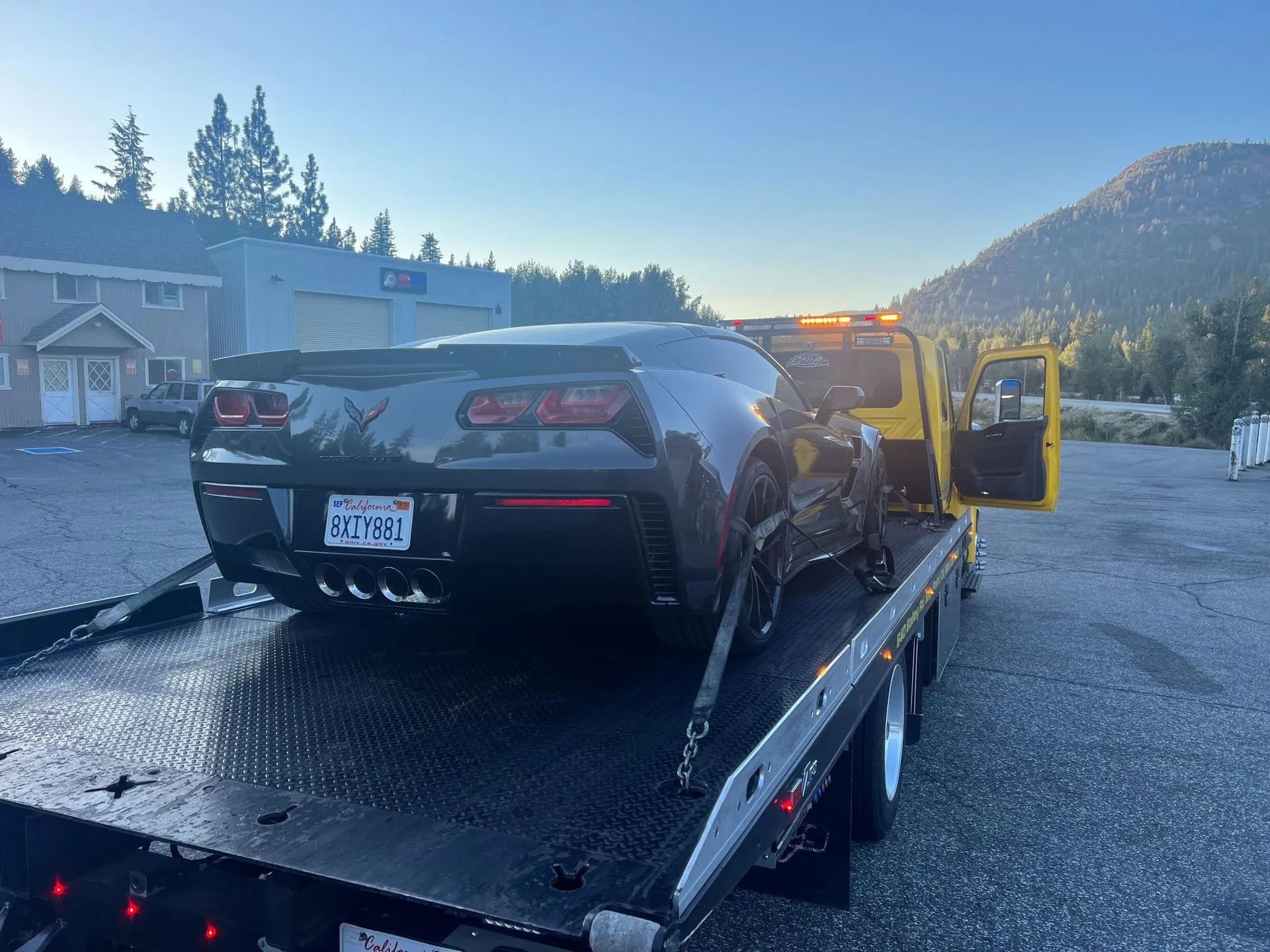
A flatbed carrier is the only appropriate towing method for most luxury vehicles with low ground clearance, all-wheel-drive systems, or adaptive suspension. Wheel lift towing, where two wheels remain on the ground while the vehicle is dragged by the raised axle, creates driveline rotation in non-towed axles on any AWD platform. For vehicles like the Porsche Cayenne or Bentley Bentayga, even short distances of wheel-lift towing can introduce wear and heat into transfer case components that operate under strict lubrication and speed parameters.
The ramp angle of a flatbed also matters. A properly equipped rollback truck has a hydraulic tilt angle designed to load a vehicle with as little as 3.5 inches of ground clearance without contacting the front air dam, diffuser, or rocker panels. An improvised loading method using ramps of the wrong angle or incline will drag those components against the deck edge, producing cosmetic and structural damage that begins at the first contact.
Wheel Straps, Load Binders, and Soft Tie Attachment
Professional operators use vehicle-specific wheel net systems or soft loop wheel straps that secure the tire at four points without touching the wheel finish, brake caliper, or rotor. A chain or ratchet strap attached directly to an alloy wheel will damage the finish and, depending on the angle, introduce a torsional load into the hub bearing that causes premature bearing failure. On carbon ceramic brake systems, which are standard on many AMG, M, and RS models, contact with a strap or chain against the rotor surface can micro-fracture the ceramic matrix without leaving any visible mark.
WARNING: If your luxury vehicle has carbon ceramic brakes and was towed using a wheel lift or chain attachment that contacted the rotor, have the rotors inspected with a penetrant dye test before driving at speed. Carbon ceramic rotor failures under hard braking are sudden and complete, with no warning progression.
Regional Conditions in Concord That Raise the Stakes
The Contra Costa County driving environment introduces specific factors that make proper towing even more critical for luxury vehicle owners in this area.
Heat and Pavement Conditions on Local Roads
Concord regularly reaches temperatures above 100 degrees Fahrenheit during summer months, and pavement temperatures during peak afternoon hours can exceed 150 degrees on heavily trafficked corridors like Willow Pass Road and Clayton Road. When a vehicle breaks down in these conditions and is left sitting on hot pavement while waiting for a tow, tire sidewalls soften and become more vulnerable to bead damage if the vehicle is moved with a flat tire or low tire pressure using improper equipment. A flatbed operator trained for luxury vehicles will assess tire condition before loading and use appropriate protective material to prevent rim-to-pavement contact during the loading process.
Interstate 680 and Highway 4 Breakdown Scenarios
Breakdowns on I-680 or Highway 4 near the Monument Boulevard interchange present specific challenges. These corridors include high-speed merge zones, concrete jersey barriers with minimal shoulder clearance, and heavy truck traffic that creates turbulence affecting a vehicle during loading. A flatbed tow truck positioned on a narrow shoulder in these conditions requires the operator to load the vehicle using a remote control winch system that keeps the operator clear of the travel lane. That equipment and that protocol are not part of any improvised towing arrangement.
TIP: If your vehicle breaks down on I-680 or Highway 4, stay inside with seatbelt fastened until a professional tow unit is positioned and the operator signals that the shoulder is secure. A stationary vehicle on a high-speed shoulder presents a serious secondary collision risk, and the tow operator's positioning and lighting setup are part of your protection.
Long-Term Consequences That Surface After the Tow
The most deceptive aspect of DIY towing damage on luxury vehicles is the delay between when damage occurs and when it becomes detectable.
Alignment and Suspension Geometry
Modern luxury vehicles use multi-link rear suspension systems with extremely tight alignment tolerances. A Mercedes E-Class rear suspension, for example, specifies camber tolerances of plus or minus 0.5 degrees and toe settings measured to within 0.1 degrees. A tow that introduces even a minor lateral load into the rear subframe through improper attachment can shift those values beyond specification without producing any visible bending or distortion. The result is a vehicle that pulls subtly, wears tires unevenly on the inner edge, and requires a four-wheel alignment that reveals the subframe has shifted, a repair that goes far beyond wheel adjustment.
Electronics and Sensor Systems
Luxury vehicles carry dense networks of proximity sensors, ride height sensors, active roll stabilization modules, and adaptive damper controllers that are calibrated to specific mechanical positions. When a tow strains the chassis in an unintended direction, sensor mounting brackets can shift, wiring harnesses can stretch, and calibration values stored in the suspension control module can fall outside their valid range. These failures do not always generate immediate fault codes. Some surface only under specific driving conditions, producing intermittent behavior that is expensive and time-consuming to diagnose.
Commercial drivers, rideshare operators, delivery workers, and business owners especially benefit from rapid roadside support because vehicle downtime directly affects earnings and customer commitments. Quick professional assistance helps reduce operational disruptions and keeps schedules moving.
AT Towing: Concord's Choice for Luxury Vehicle Transport
At AT Towing, we have spent 8
years developing the equipment protocols and vehicle-specific knowledge required to move high-value vehicles without introducing secondary damage. Our flatbed fleet is equipped with hydraulic tilt systems capable of accommodating ground clearances as low as 3.5 inches, and our operators are trained on the manufacturer-designated tow point locations for the luxury platforms we encounter most in the Concord California market. We use soft loop wheel strap systems on every luxury vehicle load, keeping all rigging clear of brake components, alloy finishes, and sensor housings. Our service area covers Concord, Walnut Creek, Pleasant Hill, and Martinez, and we respond to breakdown calls across the I-680 and Highway 4 corridors where shoulder conditions and traffic speeds demand precise positioning and professional loading protocols. When you call us for a
luxury vehicle tow, you are getting an operator who understands that a Porsche, Range Rover, or Mercedes is not simply a heavier standard car. It is a platform with air suspension, all-wheel-drive transfer cases, carbon ceramic brakes, and aluminum structures that each require a specific approach. That understanding is what separates a clean delivery from a repair bill that outlasts the original breakdown.